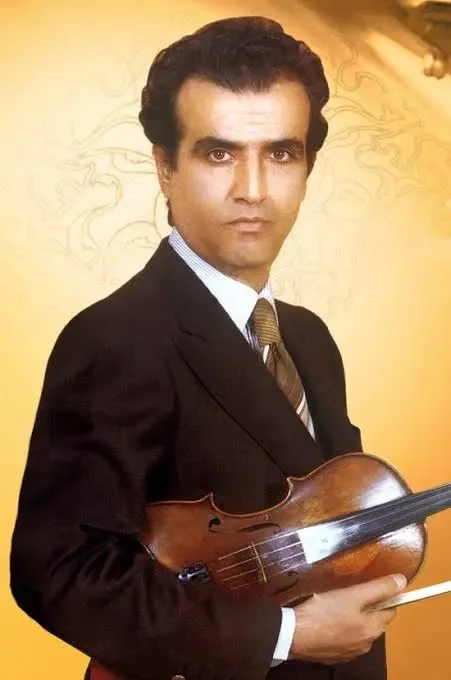
Pareeshan (Abstracted)(2017)
Written for Kronos Festival 2017
Commissioned by Kronos Quartet in memory of Iranian legendary violinist Parviz Yahaghi
For amplified string quartet using customized amplifiers brought from Iran
Parviz Yahaghi (1936-2007) was one of the most prominent Persian violinist and the composer of many iconic melodies who lived in Iran for the entirety of his life despite of the fact that he was banned from performing and publishing for almost 20 years after the Iranian revolution in 1979. He was allowed to publish two albums in late 1990’s but during his last years, he was not able physically, to play the violin any more. He belongs to the generation of performers who literally translated the Persian music for western instruments and developed their own methods of performance and sonority, in accordance to the fine details of Persian music theory. These techniques are unique and dictate that the string instrument needs be processed and amplified. The portable amplifiers are also manufactured in Iran and for the purpose of this piece, four of them travelled a long way from Tehran to San Francisco to make it to the premiere. This piece is an homage to one of Parviz Yahaghi's melodies named Pareeshan meaning, abstracted.
Parviz Yahaghi
Parviz Yahaghi (Persian: پرویز یاحقی; September 23, 1935 – February 2, 2007) was a distinguished Iranian composer and violinist. He resided in Tehran for practically his whole life, and was born and died there.
His birth name was Parviz Sedighi Parsi. He was musically educated primarily by his uncle Hossein Yahaghi, a violinist and violin teacher, from whom Parviz adopted the Yahaghi name. During his youth Parviz was exposed to many highly professional musicians in Tehran who were friends of his uncle. A notable visitor at his uncle's house was the violin teacher, composer, and musicologist Abolhasan Saba, who is credited with making improvements in violin playing technique in the Persian tradition. Saba published a two-volume training manual for the violin in 1944-45.
Starting from about 20 years, Parviz Yahaghi was employed for a little over two decades as a musician with the Iranian government-financed radio station. In the 1960s and 1970s at the radio station he composed hundreds of pieces both for violin and for celebrated singers in Iran such as Banan, Marzieh, Delkash, Pouran, Elahe, Homeyra, Mahasti, Dariush Rafei, Homayoonpour and Iraj (Hossein Khajeh Amiri). These compositions were often produced in connection with the long-running radio program Golha. Yahaghi's ability in playing violin, his compositions, and his musical director's role made him a central figure in Persian music during the 1970s.
Yahaghi's violin is tuned in a way that gives different resonances and drones to the sound, compared to standard European tuning, and he uses a number of different tuning schemes. Before the arrival of the 1979 political revolution in Iran, Yahaghi had already resigned from the government radio station and set up a recording studio of his own in Tehran. In the wake of the revolution, many of Yahaghi's friends and associates departed from Iran and did not return. But Yahaghi stayed. His wife, Homeyra, one of Iran's most famous singers, moved permanently to the USA without him. (The revolutionaries outlawed female solo singing, though women were free to continue to play musical instruments and to sing in choruses.) Yahaghi was arrested, interrogated, and released by the new regime. During the 1980s with the war between Iran and Iraq going on, he was invited by the regime to compose music, particularly patriotic music. He declined.
But the official authorities came around to viewing him with such esteem that after his death some of his musical instruments, recording equipment and other items were appropriated as national and historic property.